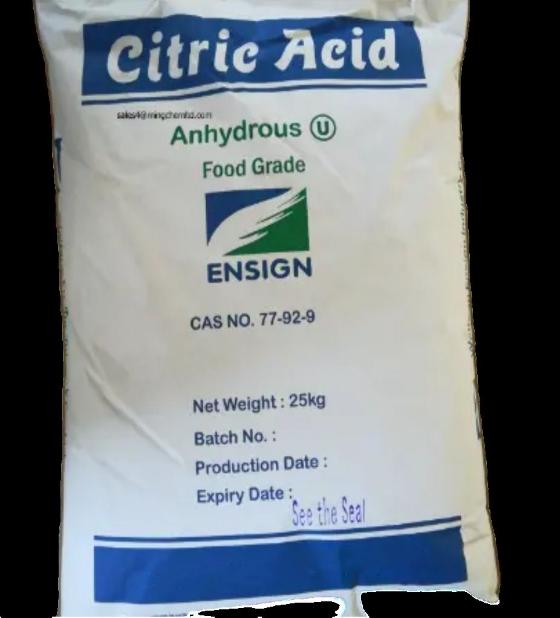

Citric acid, also known as citrate, has the molecular formula C₆H₈O₇. It is an important organic weak acid, appearing as a colorless crystal without odor and readily soluble in water, with an acidic solution. In biochemistry, it serves as an intermediate in the citric acid cycle (tricarboxylic acid cycle), which occurs in the metabolism of all aerobic organisms. Citric acid is widely used as an acidity regulator, flavoring agent, and chelating agent.
Characteristics
Name: Citric Acid
Chemical formula: C₆H₈O₇
Molecular weight: 192.12 g/mol
CAS number: 77-92-9
EINECS number: 201-069-1
Melting point: 153 to 159 ℃
Boiling point: 175 ℃ (decomposes)
Water solubility: Easily soluble in water
Density: 1.542 g/cm³
Appearance: White crystalline powder
Flash point: 155.2 ℃
Applications: Industry, food industry, cosmetics industry
SPECIFICATION:
Item | Specification |
Character | Colorless or white crystalline particles or powder. Odorless, strongly acid taste. |
Solubility | Freely soluble in water, soluble in ethanol, slight soluble in diethyl ether. |
Assay % | 99.5-100.5 |
Water % | ≤0.5 |
Sulphated Ash % | ≤0.05 |
Sulfate mg/kg | ≤50 |
Oxalate mg/kg | ≤50 |
Chloride mg/kg | ≤5 |
Heavy Metals mg/kg | ≤5 |
Bacterial Endotoxin IU/mg | <0.5 |